
JavaScript DearFlip: The Developer’s Power Tool for Platform-Agnostic 3D Flipbooks
The Need for Independence in Digital Publishing
The modern web is characterized by diversity. While platforms like WordPress, Shopify, or Drupal offer robust ecosystems, a significant portion of the web relies on custom-built frameworks—from powerful front-end libraries like React, Angular, and Vue.js to vast enterprise systems built on plain HTML, PHP, or ASP.NET.
In this varied environment, content presentation cannot be locked into a single CMS. This is where JavaScript DearFlip steps in.
JavaScript DearFlip is the dedicated, standalone JavaScript version of the acclaimed DearFlip engine. It strips away CMS dependencies (like WordPress shortcodes or Joomla components) and delivers a pure, unadulterated HTML5/WebGL solution. It is a developer-friendly, highly flexible, and incredibly powerful tool designed to integrate interactive 3D and 2D flipbooks into any kind of website, offering developers absolute control over the presentation layer and user experience.
I. Core Technology: Engineering for Realism and Performance
The technical foundation of JavaScript DearFlip is built entirely upon cutting-edge, open web standards, ensuring both maximum visual impact and broad cross-browser compatibility.
A. HTML5 and WebGL-Based Rendering
At the heart of JavaScript DearFlip’s capability lies its use of HTML5 and WebGL (Web Graphics Library).
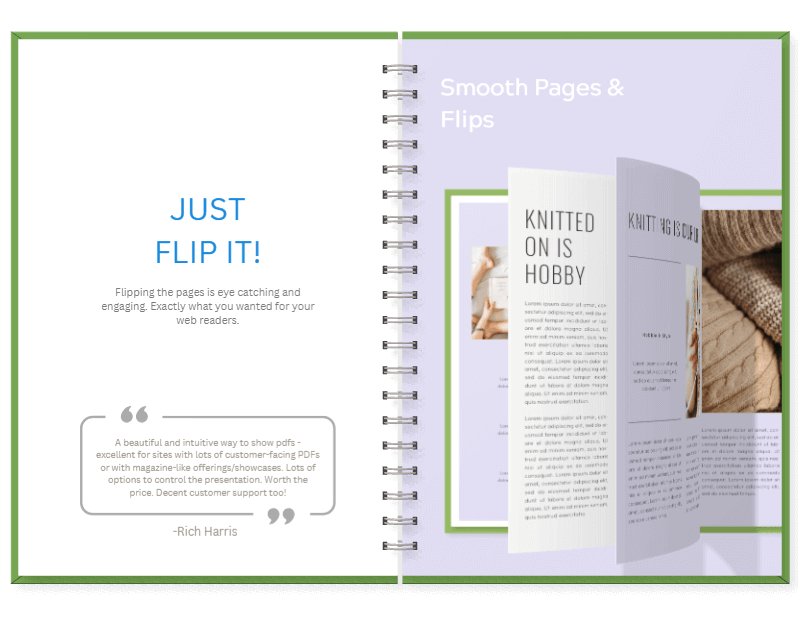
- WebGL for Realistic 3D Effects: WebGL is the engine that drives the photorealistic page-turning. It allows the browser to harness the device’s GPU (Graphics Processing Unit) to render complex, three-dimensional visuals in real-time. This is what creates the convincing illusion of depth, the subtle page curvature, and the natural shadow casting that mimic a physical book. This approach ensures that the flipbook is not a mere visual effect, but an immersive, spatial experience.
- HTML5/CSS3 for Structure and Responsiveness: HTML5 provides the semantic structure for embedding the viewer, while CSS3 ensures the flipbook is fully responsive. The viewer automatically adjusts its size and proportions to fit perfectly on any screen, from large desktop monitors and tablets to compact smartphones, delivering a consistent, high-quality user experience across all devices.
B. Lightweight and Fast Architecture
In an age where page speed is critical for SEO and user retention, DearFlip is engineered for efficiency.
- Smart On-Demand Loading (Lazy Loading): This is a defining feature for handling large publications. Instead of waiting for a 100MB, 200-page PDF to download entirely, DearFlip implements dynamic loading. It initially loads only the first few pages (typically 4) and fetches the rest sequentially as the user navigates. This approach dramatically improves the initial Time-to-Interactive (TTI) metric, saves bandwidth, and eliminates user frustration associated with slow-loading documents.
- Optimized Rendering Pipeline: The core JavaScript engine is clean and highly optimized. It avoids the performance bloat often associated with CMS plugins, ensuring that page transitions are smooth, animations are fluid, and the flipbook itself adds minimal overhead to the overall website performance.
C. The Assurance of the 2D Fallback
While 3D WebGL support is ubiquitous (covering nearly 98% of modern browsers, including IE11+), reliability is paramount. DearFlip includes an intelligent fallback mechanism:
- Intelligent Switching: If the plugin detects an older browser or a device environment where WebGL is unsupported or disabled, it automatically and gracefully transitions to a highly optimized, lightweight CSS-based 2D flip mode. This ensures that the content remains accessible, interactive, and visually engaging, guaranteeing a consistent experience even in edge cases.
II. Developer Empowerment: Custom Triggers and API Support
The core difference between a CMS plugin and a standalone JavaScript library is the level of control afforded to the developer. JavaScript DearFlip excels here, providing a robust API (Application Programming Interface) that transforms the flipbook from a static embed into a dynamic, programmable object.
A. Complete API Control
The DearFlip API provides developers with methods to programmatically control virtually every aspect of the flipbook.
| API Function Category | Description & Developer Use Case |
| Lifecycle Events | Developers can hook into events like dFlipReady, pageLoadStart, and pageLoadEnd. This is crucial for preloading content, showing custom loaders, or firing analytics events precisely when the flipbook is ready or a page interaction occurs. |
| Navigation Control | Programmatic methods like flipToPage(pageNumber), zoomIn(), and goNextPage() allow for the creation of custom navigation elements (e.g., buttons outside the viewer), external Table of Contents (TOC) menus, or in-page text links that trigger page turns. |
| Configuration Overrides | The API allows runtime modification of settings that typically need to be set upfront, such as toggling 3D/2D mode dynamically, changing the book’s color scheme based on user preference (light/dark mode), or loading a new PDF source file without reloading the page. |
| Data Retrieval | Methods to retrieve current state data, such as getCurrentPage(), getTotalPages(), or the current zoom level. This data is essential for saving a user’s progress or feeding reader metrics into a custom analytics system. |
B. Custom Triggers and Interaction
The ability to control how the flipbook opens is a critical requirement for custom websites. DearFlip offers extensive options for triggering the viewer:
- Custom HTML Elements (
_df_custom): Developers can designate virtually any HTML element—a custom icon, an image banner, a specific button, or even a text link—to serve as the trigger that opens the flipbook in Lightbox mode. This ensures the viewer seamlessly matches the custom design of any website. - Simple Div Embedding: For direct, immediate embedding, the setup remains remarkably simple, requiring just a single
divelement with a source attribute:<div class="_df_book" source="[PDF_URL]"></div>. This simplicity makes initial setup fast and easy to manage.
III. Integration Workflow for Modern Frameworks
JavaScript DearFlip is built to be a great citizen in any web environment, making it the preferred choice for development teams leveraging modern JavaScript frameworks.
A. Plain HTML and Static Sites
For traditional static websites or legacy systems, integration is straightforward:
- Include Scripts: Add the necessary DearFlip CSS and JavaScript files to the project’s
<head>or before the closing</body>tag. - Define Element: Place a
divelement on the page with the required class and thesourceattribute pointing to the PDF or images. - Initialization: The script automatically finds these elements and renders the flipbook, requiring minimal manual JS configuration.
IV. Beyond PDFs: Flexibility in Content Source
While its primary purpose is converting PDFs, JavaScript DearFlip’s engine is versatile enough to handle various content types, further enhancing its flexibility for developers.
A. Image Flipbooks
DearFlip is fully capable of creating visually captivating flipbooks from a series of images.
- Use Case: This is ideal for photo albums, lookbooks, graphic-heavy portfolios, or visual documentation where each page is a pre-rendered image (PNG, JPG).
- Implementation: Instead of a single PDF URL, developers provide a list of image URLs in the HTML syntax. The engine then renders these images into a dynamic, interactive flipbook, perfect for showcasing visual content without the overhead of PDF processing.
B. Content Management and Updates
For developers, managing and updating documents is a critical concern.
- PDF Preference: DearFlip strongly recommends using PDFs over images for lengthy documents. This is because PDFs are easier to manage—a single file needs to be updated instead of hundreds of images—and they ensure text is vector-based and crisp on all screens.
- Simple Source Swapping: Updating the content is as simple as replacing the PDF file at the source URL. The flipbook dynamically loads the new content, ensuring a friction-less content update pipeline.
V. Strategic Applications for Agencies and Enterprise
The standalone nature of JavaScript DearFlip makes it uniquely suited for large-scale, enterprise, and agency use cases where multi-platform deployment and customization are requirements.
A. Multi-Platform Deployment (Agency Use)
Agencies often manage websites across diverse client platforms (Shopify, custom PHP, static portfolio sites, etc.). With the JS version, they can:
- Standardize Presentation: Use the same high-quality flipbook solution, branded and customized, across all clients, regardless of their underlying CMS.
- License Efficiency: The multi-site licensing options are specifically designed to cover multiple client installations, offering a cost-effective way to deliver a premium feature across a portfolio of sites.
B. Intranet and Server-Side Applications (Enterprise)
Large organizations utilize internal servers and intranets for documentation, HR manuals, and training materials. These environments rarely use public-facing CMS platforms.
- Internal Documentation: DearFlip can be deployed within proprietary systems to display large documents (like compliance guides or product specifications) in an engaging, searchable, and standardized viewer.
- Data Security: By running entirely on the client-side using HTML5 and JavaScript, the core flipbook engine can be deployed without complex server-side setup, simplifying the process of displaying secure internal documents.
Conclusion: Unleashing Content with Unrestricted Freedom
JavaScript DearFlip represents the pinnacle of digital publishing flexibility. By offering a robust, API-driven solution built on the power of HTML5 and WebGL, it provides developers with unrestricted freedom to integrate stunning 3D interactive content into any web environment.
From creating dynamic catalogs on a custom e-commerce platform to embedding training manuals within a corporate intranet built on Angular, the JavaScript version of DearFlip ensures that your content is lightweight, high-performing, and always delivered with the maximum visual impact. It is the definitive tool for developers seeking to transform static documents into highly engaging, cross-platform reading experiences.